Shadow Data / Privacy education & applied AI
A few small facts. A surprisingly convincing story.
An interactive privacy education project that helps older adults and their families see how everyday details can be used to make a scam feel personal.
Collaborative project · Invite-only preview
The problem
“Be careful what you share” is easy advice to give and hard advice to make useful. The missing piece is showing how a handful of ordinary details can be combined into a story that feels familiar enough to trust.
A clearer way in
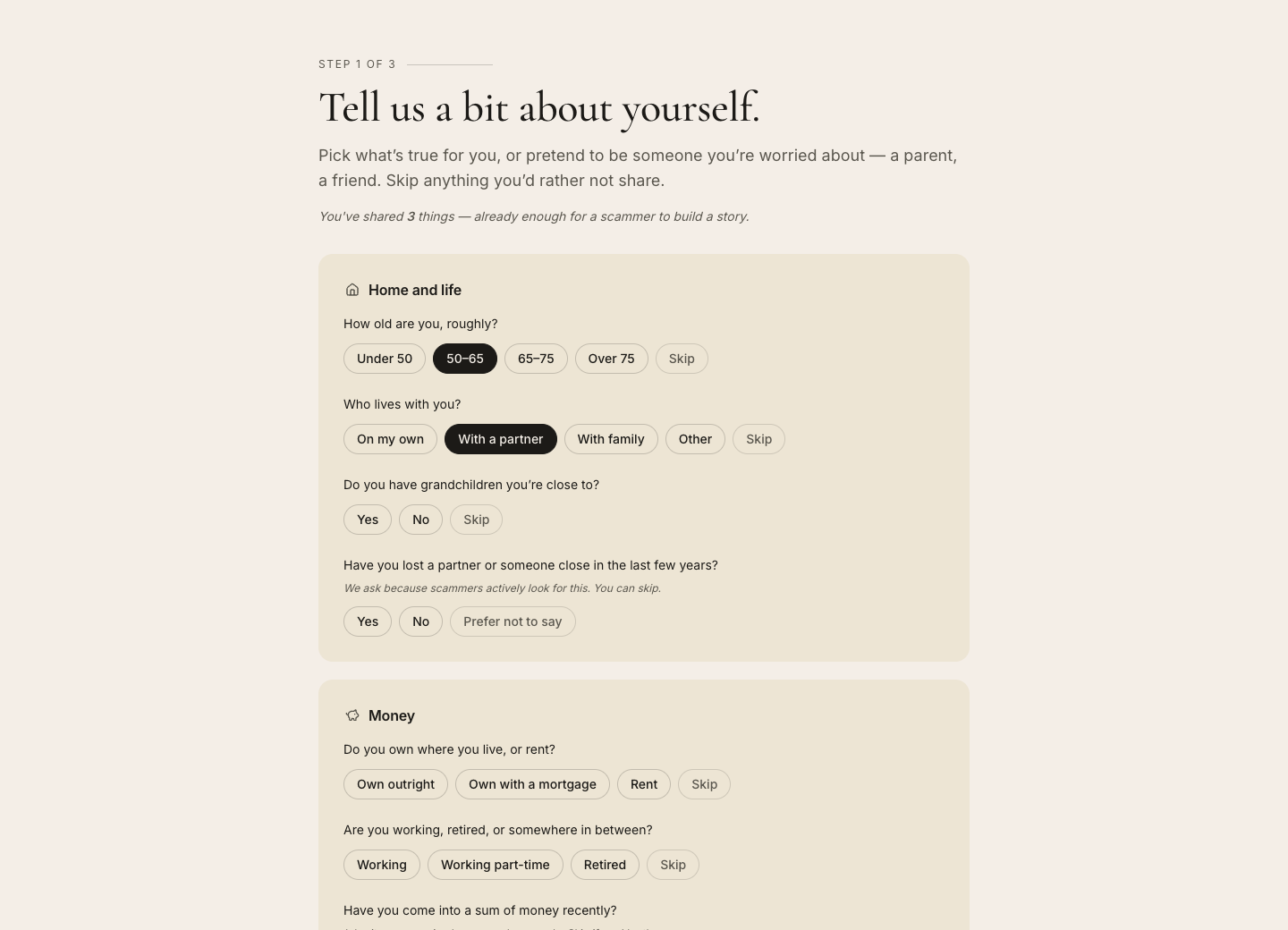
The project evolved from an abstract demonstration of data inference into a focused experience for older adults and the people looking out for them. The question at its center became “How did they know that about me?” Plain-language questions, optional answers, and a calm visual design make the subject approachable.
What I built
I developed the web application that turns that idea into a guided experience. Visitors choose a few details, see the assumptions a scammer might make, and explore an illustrative message thread. The experience then moves from recognition to action, with practical habits, a printable guide, and ways to share the lesson with someone they care about.
Where AI fits
A curated library of scenarios gives the experience its structure. AI selects and adapts a scenario to the chosen answers, while validation and output filters constrain what can be shown. Each scenario also includes a written fallback so the experience can still work when the model is unavailable. The goal is to demonstrate how assumptions can be made, not to present those assumptions as facts about a person.
Where it stands
The application is in an invite-only preview for partners and reviewers. It is a collaborative project in development, with preview access available by request through the project site.
Make the risk understandable. Then give people something useful to do.
Another kind of problem
Dudley Farm